
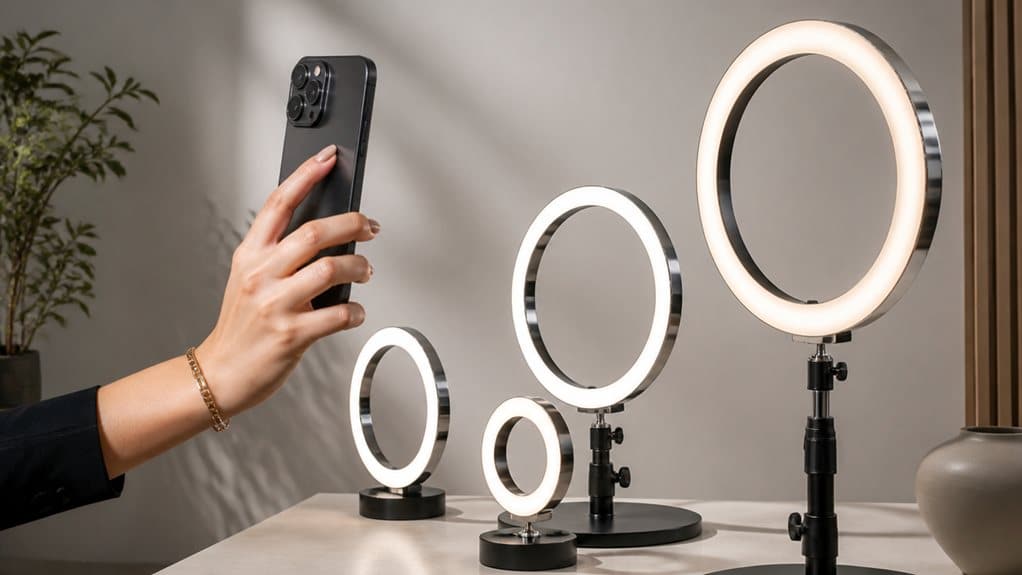
If you’re mainly taking selfies, a 6–8-inch clip-on light works well and won’t block your phone’s camera. For makeup routines or general video, go with 10–14 inches for even facial coverage. Streaming or video calls benefit from 14–18 inches, while full-body shots or wider frames need 18–26 inches. When unsure, a 10-inch model is a safe default. The size details below will help you match your exact needs.
At a Glance
- For selfies, choose a 6–8 inch clip-on ring light for portability without blocking your phone camera.
- Close-up makeup or beauty videos work best with 8–12 inch rings for even facial coverage.
- TikTok, Reels, or general video work suit a 12–18 inch ring light for balanced coverage.
- Streaming, video calls, or upper-body framing benefit from larger 18–26 inch ring lights.
- Position the ring light at eye level, 45–60 cm away, angled slightly downward for best results.
Introduction
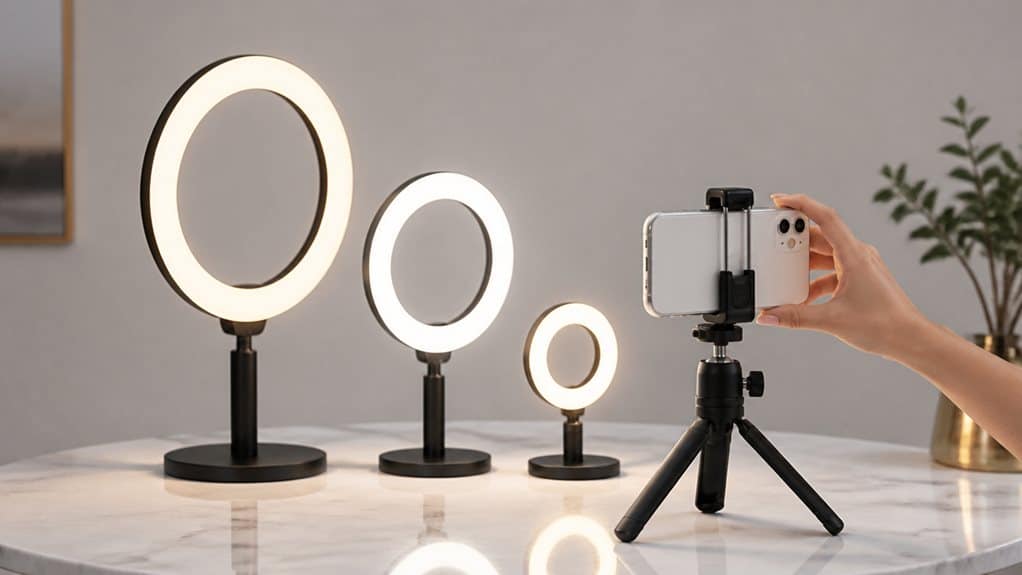
If you’ve ever propped up your phone for a video call or a selfie and noticed how flat or shadowy your face looks, a ring light can fix that problem quickly. A phone ring light adds continuous, even illumination around your face, softening shadows and reducing the tired, washed-out look that ordinary room lighting often creates.
But not every ring light works for every situation. Diameter, mounting style, and brightness all affect how well a light suits your setup, whether you’re filming videos, joining calls, or snapping quick selfies. Most ring lights range between 10 and 18 inches, with the size specification usually referring to the outer diameter.
This ring light size guide walks through the practical differences between compact clip-on models and larger tabletop or tripod options, so you can figure out the best ring light for selfies, portraits, or everyday content without guessing.
Quick answer: Which ring-light size should you choose?
Size is the single biggest factor in how a ring light performs, more vital than brand or price. Instead of scrolling through endless options, match the size to what you actually shoot.
Size matters more than brand or price. Match your ring light to what you shoot, not the other way around.
Here’s a quick breakdown:
- 10 to 12 inches: ideal for close-up selfies, best paired with a ring light with phone holder for stability.
- 14 to 18 inches: great for makeup routines and general ring light for videos work, since it covers your whole face evenly.
- 18 to 26 inches: suited for streaming or video calls, giving a wider light spread for bigger frames.
- 10 to 16 inches: the sweet spot if portability matters more than extra coverage. Larger rings in this range also tend to offer softer, more enveloping light that flatters skin tones on camera.
Pick based on your main use, not the largest size available.
How a ring light improves selfies and videos
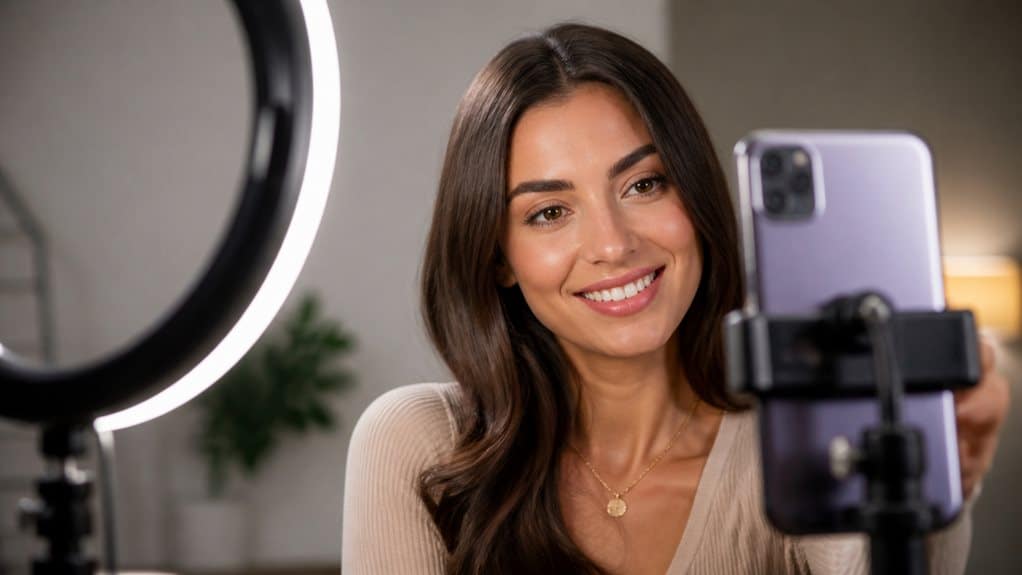
When you position a ring light around your camera lens, the light wraps around your face instead of hitting it from one side, which gives you more even facial lighting.
This setup also softens shadows under your eyes and along your nose, since the light isn’t coming from a single harsh angle.
As a bonus, the consistent brightness helps your skin tone look more uniform across your face, rather than patchy or unevenly exposed. This even light also creates a catchlight in the eyes, giving your selfies and videos a more vibrant, lively appearance.
More even facial lighting
Uniform brightness is the whole point of a ring light’s circular design. Instead of hitting your face from one side, the light wraps around your camera lens and reaches you from multiple angles at once. This spread reduces the patchy, uneven look that a single lamp or window often creates.
Here’s what makes this setup effective:
- Circular shape spreads light evenly instead of concentrating it in one spot
- Camera-center placement lets light surround the lens while facing you directly
- Frontal positioning keeps your forehead, cheeks, and chin comparably lit
- Height and angle adjustments help avoid shadows pooling under your eyes or nose
This balance is why ring lights get called “beauty lights”—they’re built to flatter faces on camera, not entire rooms. Many models also let you adjust the color temperature to make skin tones look warmer or cooler depending on your setting.
Softer shadows
Softening harsh shadows is another reason ring lights work so well for selfies and video calls. A ring light’s circular shape acts as a broad light source, which spreads illumination more evenly than a small, direct light.
Larger fixtures soften shadows more; an 18-inch ring light produces gentler results than a 10-inch one, though 10 to 12 inches usually works fine for close-up shots.
Placement matters just as much as size. Center the light in front of your face, at or slightly above eye level, angled down about 10 to 15 degrees. This reduces chin and jaw shadows.
Keep the light around arm’s length, or 45 to 60 centimeters, away.
Turn off overhead lights so your ring light stays the main light source. Beyond reducing shadows, this even illumination also creates flattering catchlights in your eyes that make you appear more engaged and alive on camera.
More consistent skin tones
Since your camera reads light before it reads color, an evenly lit face naturally looks more balanced in tone. A ring light spreads illumination across your whole face instead of hitting one side harder than the other, so your cheeks, forehead, and chin come out looking closer in shade on screen. This even, low-wavelength illumination even mirrors the way red light therapy is used to stimulate skin cells and improve overall tone.
A few adjustments help you get this right:
- Color temperature: aim for 4000K–5500K, leaning neutral white for accurate skin rendering
- Placement: keep the light at or slightly above eye level, never overhead
- Distance: stay a moderate distance away to avoid hot spots
- Brightness: start low and raise it only until tone looks even
Testing your setup in the same room beforehand helps you catch inconsistencies before recording.
Ring-light sizes explained
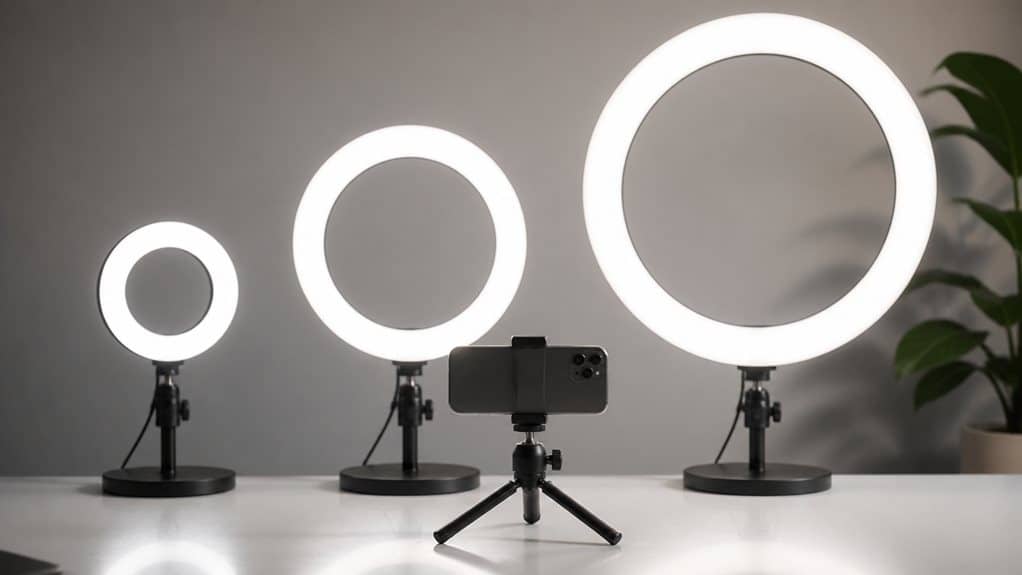
Ring lights come in a wide range of sizes, and the right one depends on how you shoot and what you’re shooting.
You’ll find everything from clip-on mini lights that attach to your phone to large creator ring lights on stands, each suited to different distances and setups. Sizes generally range from 10 inches up to 22 inches, with larger diameters offering more coverage for full-body or studio shots.
Below, you’ll see how clip-on models, small tabletop lights, medium tripod versions, and large ring lights compare in coverage, portability, and price.
Clip-on mini ring lights
Clip-on mini ring lights are the smallest category in this guide, and they’re built for one job: adding soft, even light right at the source of your shot. These units, usually 4–7 inches wide, clip directly onto your phone or laptop, keeping the light close to your face for selfies, video calls, and quick makeup checks. Effective range is limited, so these lights work best within 60 cm of your device.
A 6–7 inch model tends to hit the sweet spot, offering enough LEDs and diffusion for softer light without becoming bulky. Before buying, check a few things:
- Clip strength: rubberized grips hold phones securely without slipping
- Brightness levels: at least three settings for different rooms
- Color temperature control: helpful near windows or mixed lighting
- Charging type: USB-C keeps things simple for daily use
If you rarely move more than arm’s length from your camera, a mini ring light should be enough.
Small tabletop ring lights
A step up in size brings a step up in convenience, and that’s exactly what small tabletop ring lights offer. Falling in the 8- to 12-inch range, these lights sit on a stand or base rather than clipping to your phone, giving you a stable, hands-free setup for desk work.
They’re a strong match for talking-head videos, livestreams, and makeup tutorials, where you stay within a set distance from the camera. An 8-inch model keeps things portable, while a 10-inch option balances size with stronger output for small product shots. In fact, the top-rated 10-inch model tested offered 11 brightness levels across three lighting modes for added versatility.
Keep in mind, smaller rings can create harder shadows on curved surfaces. If you need softer light for glossy skin or objects, consider sizing up toward 14 inches instead.
Medium ring lights with tripods
Sweet-spot sizing is what defines this category: most medium ring lights fall between 12 and 14 inches in outer diameter, giving you a middle ground between compact clip-ons and bulky studio setups.
This range works well because it spreads light across a wider area, cutting down on the harsh hotspots you often get with smaller lights.
A tripod is what makes this size practical, since it lets you control height and angle instead of balancing the light on a table. This size range is also well suited to makeup tutorials, where even illumination across the face matters most.
- Great for TikTok, Reels, and YouTube Shorts framing
- Suited to solo videos and close-up content
- Works well for video calls with even facial coverage
- Ideal face distance sits around 12 to 18 inches
Position the light at eye level with a slight downward tilt for the most flattering shadows.
Large creator ring lights
Once you move past 18 inches in diameter, you’re in the territory of large creator ring lights, designed for streaming, professional vlogging, and setups where broader light coverage matters more than portability.
Models in the 18 to 26 inch range spread light over a wider area, which helps if you’re recording video calls or livestreams where the background also needs some illumination.
Look for adjustable brightness, a color temperature range (often 3000K to 6500K), and a CRI of 95 or higher, since this affects how accurately your skin tone appears on camera.
Keep in mind that large ring lights need more physical space and work best when you’re sitting a bit farther from the camera, not for tight close-ups.
Important buying criteria
Once you’ve settled on a size, the next step is checking the features that affect everyday usability.
Brightness levels, color temperature, power supply, and mounting stability all determine whether a ring light fits smoothly into your routine or becomes a hassle. These criteria matter more than flashy marketing claims, so it helps to know exactly what to look for before you buy.
Brightness levels
Brightness levels often matter more than any other spec when you’re choosing a phone ring light, since the wrong setting can either wash out your face or leave you looking dim on camera. Look for physical buttons or a slider rather than app-only controls, so you can adjust quickly mid-shoot. At least 3–5 brightness levels gives you enough range for different tasks.
- Video calls: aim for around 350–500 lux at 45 cm
- Makeup application: look for 600–800 lux at 30 cm for accurate color
- Outdoor vlogging: 1,000+ lux at 60 cm helps overcome daylight
- Close-up selfies: lower brightness prevents washed-out features
Higher output isn’t always better, and stable, flicker-free dimming at medium settings often works better than maxing out brightness.
Adjustable color temperature
While brightness controls how much light hits your face, color temperature determines what that light actually looks like, and it’s measured in Kelvin (K). Lower numbers look warmer, higher numbers look cooler, and most ring lights range from around 3000K to 6500K.
Warm tones (3000K–4000K) suit cozy indoor selfies, while neutral settings (4000K–5000K) work well for everyday photos. Daylight tones (5000K–6500K) give a crisp, bright look often used for video calls.
For video, 3200K matches tungsten lighting and 5600K matches daylight setups. Matching your light to your camera’s white balance helps avoid odd color casts.
Look for continuous adjustment rather than just a few fixed steps, and check that brightness stays consistent across the whole range. This flexibility matters most if you shoot in different rooms or at different times of day.
Power supply
Getting the color right only matters if your light actually turns on when and where you need it, and that’s where power supply comes in.
Ring lights use a few different power setups, and each one fits different habits.
- USB power: draws from a power bank, laptop, or car port, ideal for travel and setups without a nearby outlet.
- Built-in rechargeable battery: cuts cable clutter, with mAh capacity telling you how long it’ll last.
- Disposable batteries: handy for quick, occasional use when charging isn’t convenient.
- AC wall power: best for long studio sessions, since runtime isn’t limited by charge.
Match the power type to your setup.
If you’re often on the go, USB or battery power makes more sense than a wall-only design.
Phone holder and tripod stability
A wobbly phone mount can undo all the work a good ring light does for your selfies and videos. Look for clamps with a screw-tightening mount, since spring clamps loosen over time. Rubber or silicone padding grips your phone case better and prevents slipping, but check that the width range, usually 2.4 to 3.7 inches, fits your phone with its case on.
For tripods, wider leg spread means better balance, especially on uneven ground. Keep the center column low to avoid tipping, and make sure leg locks click firmly into place. Test stability by tapping the legs gently; the setup should settle within a few seconds, not wobble for five or longer.
A stable base matters more than extra height when you’re filming or taking selfies.
Best ring light by use case
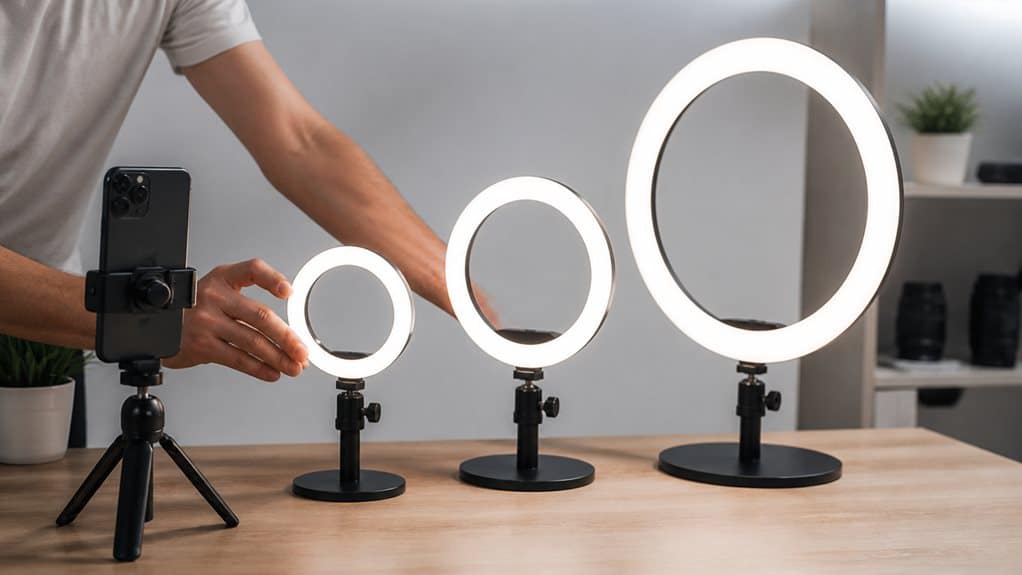
Not every use case calls for the same ring light, and matching size to your setup makes a real difference.
Selfies and travel favor small, portable rings, while makeup application and video calls often benefit from larger, softer light sources.
Below, you’ll find guidance for choosing the right ring light based on how and where you plan to use it.
Selfies and travel
Regarding everyday selfies, you don’t need the biggest ring light on the market. A compact 10-to-12-inch clip-on or tabletop model handles most close-up shots since your face fills the frame at just a few feet away. What matters more than size is how the light renders your skin tone, so look for a high CRI rating, which simply means colors appear natural rather than washed out or off-color.
For travel, prioritize portability over power. A smaller, foldable ring light packs easily and sets up quickly in hotel rooms or tight spaces.
Keep these travel priorities in mind:
- Compact diameter for easy packing
- Lens-centered design for balanced framing
- Lightweight clip-on attachment for phones
- Quick setup without extra tripod space
Makeup application
Once you’ve settled on a size that suits your travel habits, the next question is what you actually need the light for. If makeup application is your main use, size and color accuracy matter more than portability alone.
For studio work, an 18-inch ring light gives broad, even coverage that softens shadows around the nose and chin, making blending easier. Mobile artists often do better with a 10-inch, USB-powered light and a compact tripod, since setup speed matters more than maximum coverage on location.
Whichever size you choose, look for CRI 90+ and a 2800K to 6500K range. This helps you judge foundation, blush, and lip color accurately, so you’re not surprised by how shades look once you step into different lighting.
TikTok and Instagram videos
Since TikTok and Instagram videos often mix close-up talking segments with wider, full-body shots, choosing the right ring light size depends on how you plan to film.
If you’re seated close to your phone, a smaller light can work, but most creators get better results from a mid-size or larger option:
- 10–12 inches: fine for close-up desk content, but limited to filming within about 18 inches of the camera.
- 12–18 inches: the most versatile range for Reels and TikTok, balancing coverage with a manageable footprint.
- 18 inches: a strong default for home or bedroom setups, since it fills a standard room and supports upper-body framing.
- 21 inches: best for full-body or wide-frame shots, where you’re standing several feet from the light.
Match the size to your typical shot, not just your budget.
Video calls and streaming
For video calls and live streaming, the ideal ring light size depends less on room decor and more on how far you sit from your camera. If you sit at arm’s length, a 10–12 inch ring light gives enough coverage without crowding your desk.
For most calls, 10–14 inch models strike a good balance between light spread and workspace fit, and 10 inch units work best with laptop webcams or tight setups.
If you’re streaming or hosting webinars, consider a 14–18 inch light. These larger sizes soften shadows, cover more of your face, and create a studio-like glow that reads well on camera.
Look for adjustable brightness and USB power, since these features let you adapt to changing room light without extra equipment.
Amazon buying recommendations
Shopping for a ring light on Amazon often comes down to matching a few key specs to how you’ll actually use it, rather than picking the highest-rated option by default. Before adding anything to your cart, check the listing details closely.
- Clip-on ring lights: compact, USB-powered, and best for quick selfies or laptop video calls where desk space is limited
- Tabletop ring lights: medium-size units with adjustable stands, suited for mixed selfie and video use at a desk
- Ring lights with tripods: larger setups offering wider coverage, ideal for talking-head videos or full-body framing
- Accessory bundles: look for included phone mounts or remotes if you want fewer separate purchases
Match LED count, dimming range, and color temperature to your typical lighting conditions before deciding.
Frequently asked questions
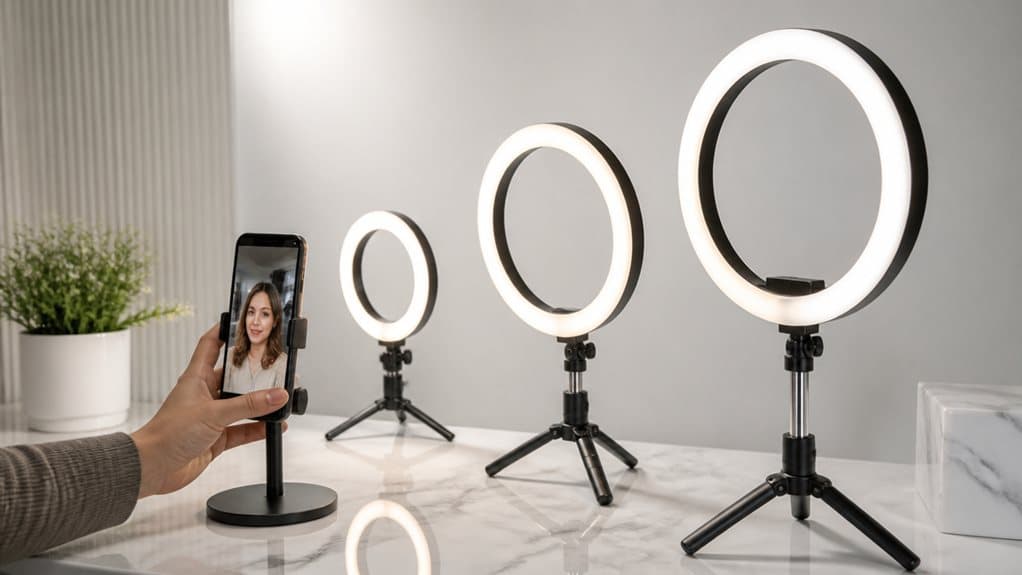
Once you’ve narrowed down the type of ring light you want, a few practical questions tend to come up before you actually buy one.
What size ring light do I need? A 10-inch ring light works well for most selfies and video calls, offering enough coverage without taking up too much space.
Does color temperature really matter? Yes. Warm light suits relaxed, intimate shots, while cool light gives a sharper, more defined look.
Can I skip a ring light entirely? If your phone has a strong front camera and flash, you may not need one for casual use.
Is a remote necessary? It’s helpful for hands-free photos, but not indispensable if you’re comfortable using a timer.
Conclusion
Whether you’re taking quick selfies or hosting daily video calls, choosing the right ring light comes down to matching size, brightness, and format to how you actually shoot. There’s no single “best” option, since your setup, room, and habits shape what works.
Keep these points in mind when deciding:
- Selfies and mobile use: a 6–8 inch clip-on ring light stays light, portable, and easy to position without blocking your camera.
- Video calls and desk setups: an 8–10 inch tabletop or tripod-mounted ring light gives broader, more even coverage for fixed framing.
- Dim rooms: look for adjustable brightness in the 400–600 lux range.
- Color accuracy: adjustable color temperature helps skin tones look natural across different lighting conditions.
Match size to your habits, not trends, and you’ll get consistently better results.
Frequently Asked Questions
Can a Ring Light Replace Natural Window Lighting Entirely?
No, it can’t fully replace it. You’ll get even, direct light and a nice catchlight, but window light’s natural softness and color are hard to match—try combining both for the best results.
Do Ring Lights Work Well With Phone Cases Still Attached?
Yes, most clip-on and tripod ring lights work fine with your case on. Clamp mounts grip securely around standard cases, while magnetic mounts need a MagSafe-compatible case for proper alignment and stability.
Will a Ring Light Drain My Phone’s Battery Faster?
Only if it draws power directly from your phone’s USB port. Battery-powered or plugged-in ring lights won’t touch your phone’s charge, so you’ll get longer sessions without worrying about sudden power drops.
Can I Use a Ring Light for Group Selfies Effectively?
Yes, but you’ll want a larger ring light—14 to 18 inches—for even coverage across multiple faces. Position it at eye level, tilt slightly downward, and stand far enough back to fit everyone in frame.
Do Colored Ring Lights Affect How Skin Tones Appear?
Yes, they do. Colored light shifts your skin’s warmth and saturation—red/orange warms things up, blue can darken redness. Stick with soft white or yellow-white light if you want your natural tone to show accurately.
Summary and Conclusion
Choosing the right ring light comes down to matching size to purpose. If you mostly take quick selfies, a small clip-on model gives you enough brightness without added bulk. For video calls or tutorials at a desk, a mid-size ring light offers better coverage and more even lighting. Content creators filming longer videos usually benefit from larger, tripod-mounted options. Think about where you’ll use it most, then pick the smallest size that still meets your lighting needs.
 English
  Español
  Français
  Deutsch
  Italiano
Leave A Comment