
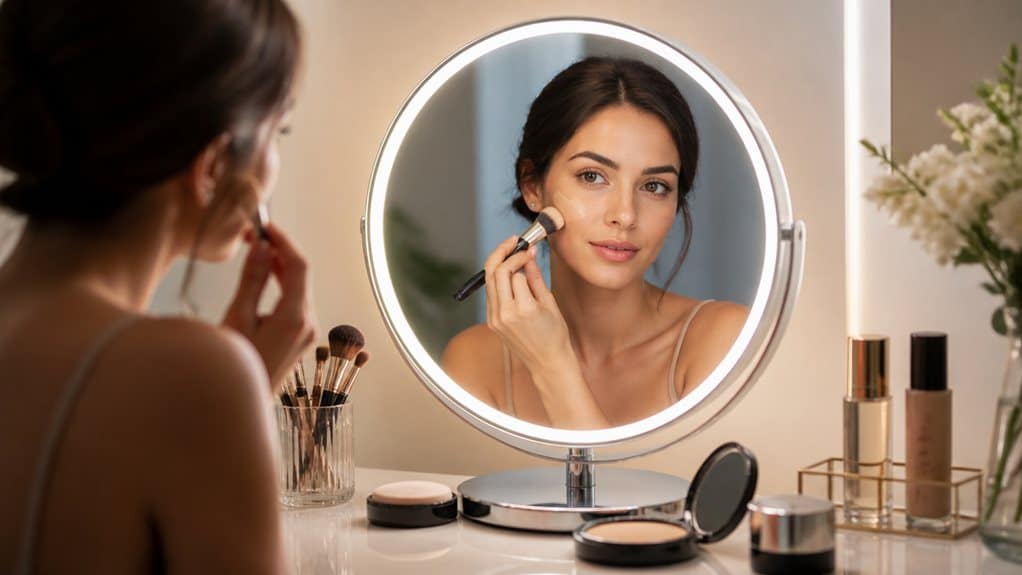
For accurate makeup, you need lighting that mimics natural daylight, not your bathroom or office bulbs. Look for a mirror with 5000K-6000K color temperature and CRI 90 or higher, since these numbers show true color rendering. Adjustable brightness matters too, since detail work needs more light than everyday checks. Warm bulbs shift shades yellow; overhead lighting hides flaws. Below, you’ll find exactly what specs and features to prioritize.
At a Glance
- Choose LED mirrors with 5000K–6000K color temperature to closely mimic natural daylight for accurate viewing.
- Prioritize CRI 90+ (and R9 above 90) to ensure true rendering of skin tones, reds, and pinks.
- Select adjustable brightness (400–800 lumens) to handle detail work, everyday application, and final checks.
- Favor diffused, eye-level lighting over overhead light to reduce shadows and reveal blending errors.
- Use adjustable Kelvin settings to accurately preview makeup across daylight, office, and evening lighting conditions.
Introduction
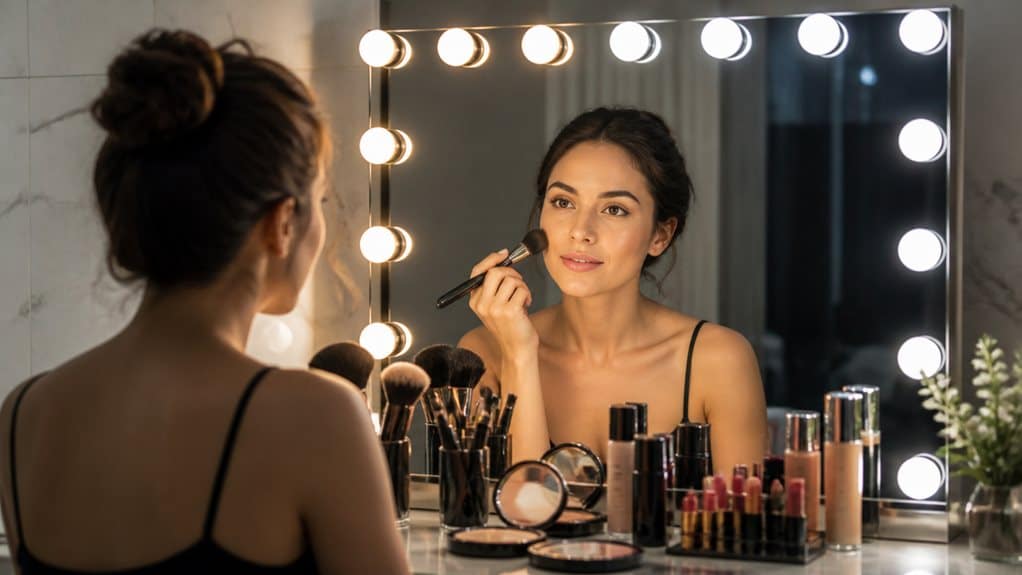
Why do your makeup and selfies look different depending on where you’re standing? Bathroom bulbs, office lighting, and outdoor sun all cast different color temperatures, which changes how your foundation, blush, and highlighter appear. A lighted makeup mirror solves this problem by placing consistent, controlled light right where you need it, at eye level and around your face.
Unlike single overhead bulbs, an LED makeup mirror surrounds your face with light from multiple angles, cutting down shadows that hide texture or exaggerate lines. This setup helps you see your skin the way a camera or another person actually will.
Finding the best lighting for makeup mirror use isn’t about buying the brightest option available. It’s about understanding color accuracy, brightness levels, and placement, which we’ll break down next. A quality mirror should also offer a Kelvin temperature around 3000K–4000K to closely mimic natural daylight for realistic results.
Why room lighting can distort makeup
Since no two rooms share the exact same lighting setup, your makeup can look completely different depending on where you check it. Warm bulbs can push foundation and blush toward yellow or orange, while cool fluorescent light can make the same products look harsh and flat. This mismatch happens because color temperature changes how your eyes read pigment.
Overhead lighting adds another problem: shadows. Without light hitting your face evenly, blending errors and texture become harder to spot, especially under the eyes and jawline. This is where a magnifying makeup mirror helps, since it lets you check close-up detail that ordinary mirrors miss. In fact, bright natural daylight is considered the best reference point because it reveals the true, unaltered shade of foundation, blush, and eyeshadow.
Any solid makeup mirror buying guide will tell you that consistent, front-facing light matters more than brightness alone for accurate color and blending checks.
Light quality explained
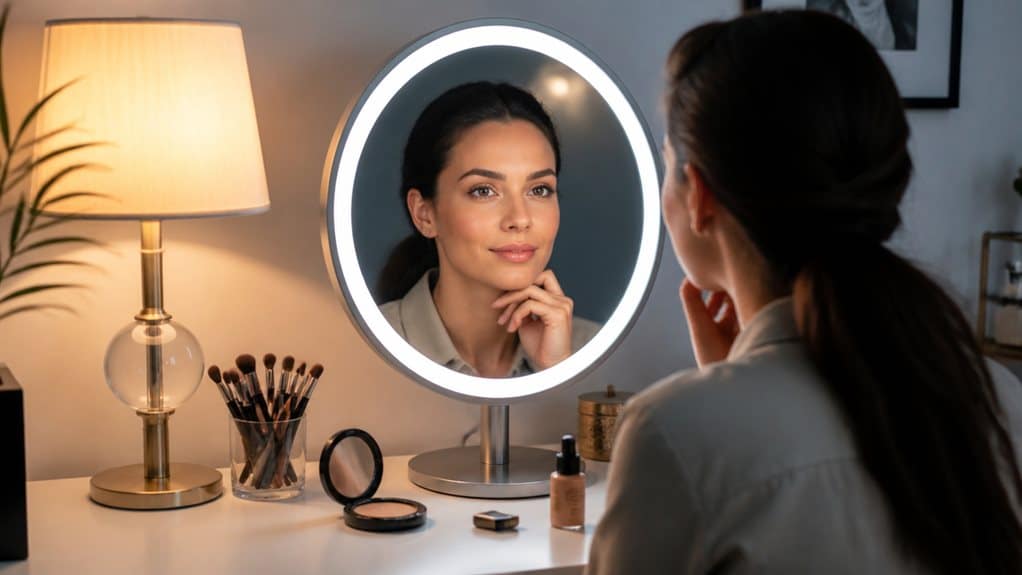
Not all lighted mirrors are created equal, and the difference comes down to three factors: brightness, color temperature, and color rendering.
Brightness determines how much detail you can see, color temperature affects whether light looks warm and yellow or cool and blue, and color rendering tells you how accurately colors appear compared to natural daylight.
Understanding these three elements will help you choose a mirror that shows your makeup as it will actually look once you step outside. The best mirrors let you toggle between multiple light temperatures so you can preview how your makeup will appear in different settings, from daylight to warm indoor lighting.
Brightness
Brightness often gets treated as a simple “more is better” feature, but that’s not quite accurate as regards makeup mirrors. What matters most is adjustability, since your face needs enough light to reveal texture and edges without straining your eyes.
For reference, 400 to 800 lumens is a reasonable range for most mirrors, and at least 800 lux at 12 inches is a helpful benchmark for precision tasks like eyeliner or blending. Too much brightness aimed straight at your face can wash out shadows you need to judge placement accurately.
That’s why dimming controls matter. You can lower brightness for evening looks, raise it for daytime accuracy, or adjust it to match changing room light throughout the day. In fact, one top-rated mirror tested offered five brightness settings, giving users precise control over intensity for different tasks.
Color temperature
Why does the color of your mirror’s light matter as much as its brightness? Color temperature, measured in Kelvin (K), describes how warm or cool your light appears. Lower numbers give off a yellow-orange glow, while higher numbers lean blue. For makeup accuracy, neutral white light works best because it mimics daylight without strong color bias.
Most experts suggest 4000K–5000K for everyday application, while 5000K–5500K offers a reliable, neutral setting for home use. If you want brighter, daylight-style precision, try 5500K–6000K. Natural daylight itself generally falls around 5000K to 6500K, which is why these ranges are recommended for accurate makeup application.
Warmer settings around 3500K suit special-event looks with a golden finish.
Since one fixed setting won’t suit every routine, a mirror with adjustable Kelvin options gives you more control across different lighting needs.
Color rendering
Even a perfectly bright mirror can still distort how your makeup actually looks if the light quality is poor. This is where CRI, or Color Rendering Index, comes in.
CRI measures how accurately a light source shows true colors, on a scale from 0 to 100, with 100 matching natural sunlight. High CRI LEDs are designed to closely mimic natural sunlight for the most accurate color rendering.
For makeup mirrors, aim for CRI 90 or higher. This range is often called the “sweet spot,” since it renders reds, pinks, and skin tones accurately.
Lower CRI lighting, around 70 to 80, can make blush look muted or foundation appear the wrong shade.
One extra detail matters: R9, a measurement of red accuracy. Look for R9 above 90, since red tones are especially sensitive to poor lighting.
Types of lighted makeup mirrors
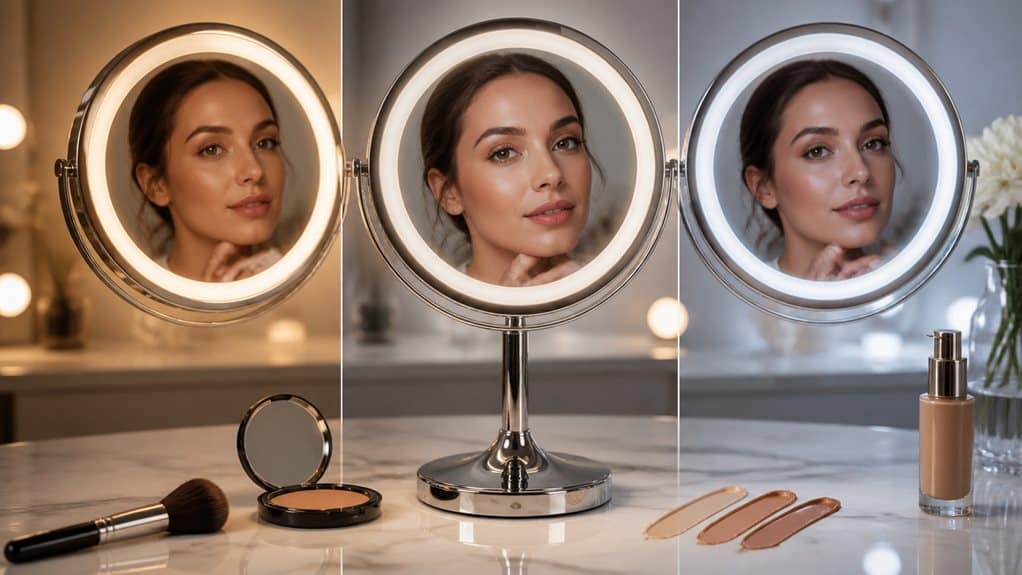
Not every lighted mirror fits the same lifestyle, so it helps to know the main types before you buy.
Tabletop and wall-mounted mirrors suit fixed setups like a vanity or bathroom, while travel mirrors and tri-fold designs offer more flexibility for smaller spaces or life on the go. Power sources vary widely, from USB rechargeable batteries to wireless charging bases, depending on the model.
Each type balances portability, power source, and viewing angles differently, so the right choice depends on where and how often you’ll use it.
Tabletop mirror
A tabletop mirror is the workhorse of most makeup routines, sitting on a dresser, desk, or bathroom counter where you can settle in for daily grooming.
You’ll find lit and unlit versions, with or without magnification, so you can match the mirror to how you actually apply makeup.
Power options vary too. Corded models suit a fixed spot, while battery-operated or USB-rechargeable versions let you move the mirror between rooms or pack it for travel.
Look for a mirror offering both a full-face view and a magnified attachment, ideally with a swiveling head. This combination lets you check general balance while still handling detail work like eyeliner or brow shaping without switching tools. The classic Jerdon 8.5 LED Lighted Tabletop Mirror, for example, swivels between 1x and 8x magnification for exactly this kind of versatility.
Wall-mounted mirror
If you’d rather free up counter space and keep your mirror at the same height every time you sit down, a wall-mounted lighted mirror is worth considering. These mirrors offer a stationary setup, which is ideal for a dedicated vanity area. Fixed placement means no adjusting angles each morning, and clutter stays off the counter. Most extendable arms fold flat against the wall and offer 360° rotation for flexible positioning.
Magnification ranges widely, from 7x up to 30x, so you can pick a level that matches your tasks.
| Magnification | Best For | Note |
|---|---|---|
| 7x-10x | Eyeliner, brows | Balanced detail |
| 15x | Close-up spot checks | Combine with 1x view |
| 30x | Extreme precision | Needs careful positioning |
Power options include corded, battery, or rechargeable, so check your outlet access before buying.
Travel mirror
While a wall-mounted mirror suits a fixed vanity spot, packing for a trip calls for something smaller and more flexible. Look for a compact, lightweight design that fits easily in a carry-on or bag. Rechargeable or battery-powered models matter most here, since you won’t always have a wall outlet nearby. USB charging is a practical bonus, letting you top up from a phone charger or power bank.
Daylight-mimicking LEDs help you apply makeup accurately in unfamiliar hotel lighting, and adjustable brightness lets you match different rooms. A built-in magnified side, often 5x, is useful for precise tasks like eyeliner or brow grooming. The Riki Loves Riki Skinny is a reader-favorite example, prized for its thin, portable design and magnetic phone clip. If you only need occasional touch-ups, a simpler corded model may still work fine at home.
Tri-fold mirror
Three-panel construction sets tri-fold mirrors apart from other lighted makeup mirror styles. A center panel holds the main mirror, while two side panels fold inward for storage or angle outward for a wider view. This layout lets you see your face from multiple sides, which is helpful when checking blending or symmetry.
Tri-fold mirrors work well because they combine several features in one unit:
- Standard center reflection for comprehensive face assessment
- Magnified side panels, often 5x or 10x, for detail work like eyeliner
- Adjustable LED lighting for even illumination
- A foldable design that’s more compact than fixed vanity mirrors
This makes tri-fold mirrors a practical choice if you want wide viewing and close-up precision without switching tools.
Choosing magnification
Magnification isn’t a one-size-fits-all setting, so it helps to match the zoom level to the task at hand.
A 1x view keeps your whole face in the frame, which is useful for checking general makeup and symmetry, while 5x brings you in close enough for brows and eyeliner without distorting your features too much.
If you need to tweeze stray hairs or inspect pores closely, 10x and higher can help, though it’s best used for short, precise tasks rather than your entire routine.
1x for overall makeup
Regarding checking your finished makeup, 1x magnification is your best starting point. It shows your face at true, normal size, so you get an honest view of how everything looks together, not just one zoomed-in feature.
- True reflection: 1x avoids distortion, giving you a realistic sense of color, blending, and general finish.
- Proportion check: It’s the easiest way to judge symmetry and balance across your whole face.
- Avoids over-correction: Since nothing looks unnaturally magnified, you’re less likely to add too much product.
- Everyday baseline: Think of 1x as your default setting, reserving stronger magnification for small detail work only.
If your lighting is bright and even, 1x is often all you need.
5x for detail work
Once you’re ready to move past a general check and into actual detail work, 5x magnification tends to hit the sweet spot. It sits at a comfortable focal distance of about 20 to 25 centimeters, so you don’t need to lean in awkwardly to see clearly. This makes it practical for shaving, brow shaping, and everyday makeup application, without pushing into the intense zoom of 10x or 15x mirrors.
| Feature | 5x Magnification |
|---|---|
| Focal distance | 20–25 cm |
| Best for | Brows, shaving, daily makeup |
| Field of view | Broader than 10x+ |
| Lighting needs | Even, bright light matters |
| User type | General, everyday use |
If close work still feels difficult, improving your lighting often helps more than increasing magnification.
10x and higher
Past the 5x range, mirrors start entering specialty territory rather than everyday-use territory. At 10x and higher, you’re no longer looking at a general grooming tool but a precision instrument meant for very specific tasks. This level of zoom reveals pores, fine lines, and tiny details you’d never notice in a regular mirror, which is helpful for careful work but overwhelming for everyday use.
Before choosing a mirror this strong, consider these factors:
- Purpose – best for tweezing, eyeliner, or lash placement, not full makeup application.
- Distance – works best when you’re close, since the field of view narrows.
- Lighting – built-in LEDs help you see clearly at this magnification level.
- Size – higher zoom mirrors tend to be bulkier, so compact portability may be limited.
Important buying criteria
Beyond lighting quality and magnification, a few practical details can make or break your daily experience with a mirror.
You’ll want to check whether brightness is adjustable, since a fixed setting rarely works for every room or time of day. Power source, mirror size, and base stability also matter, especially if you’re moving the mirror between rooms or traveling with it often.
Adjustable brightness
Not every makeup task needs the same amount of light, and that’s exactly why adjustable brightness matters so much when you’re choosing a lighted mirror. A single fixed setting can’t handle detail work, everyday application, and a final check before you leave the house. That’s why brightness control ranks high on any list of buying criteria.
Look for these features when comparing mirrors:
- Several brightness levels, not just one dim or bright option
- Controls placed within easy reach while your hands are busy
- A top setting bright enough for detail, without causing glare
- A low setting strong enough for touch-ups
Adjustable brightness works best when paired with daylight-mimicking LEDs, since color temperature and light intensity together give you a more honest preview of your finished look.
Rechargeable versus plug-in
Once you’ve settled on how bright you want your mirror to become, the next question is how that light gets powered in the beginning. Rechargeable mirrors run on a built-in battery, charged through a cable, and give you cordless flexibility. Plug-in mirrors stay connected to an outlet, offering steady power without worrying about charge levels.
| Feature | Rechargeable | Plug-In |
|---|---|---|
| Runtime | 10–100+ hours, depending on quality | Unlimited while plugged in |
| Best For | Travel, small bathrooms, flexible placement | Permanent vanity setups |
| Downside | Needs charging, roughly 5 hours to full | Requires nearby outlet |
If you move your mirror often or lack counter outlets, rechargeable models make sense. For a fixed vanity station, a plug-in mirror avoids charging downtime entirely.
Mirror size and stability
Since a mirror that’s too big or too small can throw off your whole vanity setup, getting the size right matters more than most people realize. A good starting point is comparing your mirror to your vanity or counter width, then thinking about stability and viewing needs.
- Match the mirror to your vanity width. A common rule suggests choosing a mirror 2 to 4 inches narrower than your vanity, though some guidelines allow up to 6 inches for larger setups.
- Check face coverage. You’ll want at least 8 to 10 inches of viewing width to see your whole face comfortably.
- Consider your space. Larger bathrooms can handle bigger mirrors without feeling crowded.
- Leave clearance for lighting. Side lights need room so the mirror doesn’t overwhelm nearby fixtures.
Amazon buying recommendations
When you’re scrolling through Amazon’s endless selection of lighted makeup mirrors, it helps to have a short mental checklist rather than relying on flashy product photos alone.
Initially, check whether the listing mentions adjustable color temperature and brightness control, since these features matter most for accurate shade matching.
Next, look for daylight-mimicking LEDs in the 5000K to 6000K range, which come closest to natural outdoor light.
Favor listings offering 5x magnification, as it balances detail work with everyday usability.
Confirm whether the mirror is battery-operated, corded, or rechargeable, and match that to where you’ll actually use it.
Ultimately, skim reviews and descriptions for mentions of shadow reduction or even lighting, since that affects how reliable your reflection really is.
Frequently asked questions
What color temperature is best for makeup application? Daylight-mimicking light in the 5000K to 6000K range is the most commonly recommended choice, since it shows your skin tone and cosmetic shades close to how they’d appear outdoors.
If you want lighting closer to office conditions, 4000K to 4600K works well, while 2700K to 3500K suits evening application.
- Best all-around choice: adjustable color temperature and brightness for testing multiple environments.
- Best magnification for daily use: 2x to 5x, depending on detail needs.
- Best combo setup: a full-face 1x mirror paired with a magnified mirror.
- Best for close tasks: 10x magnification for tweezing or lash application.
Conclusion
Choosing the right lighted makeup mirror comes down to matching a few key specs to how you actually apply makeup and take selfies. Look for CRI 90+ and a color temperature between 4000K and 5000K, since these two factors have the biggest impact on how accurately you see your skin tone and makeup shades. A tabletop LED mirror works well for everyday routines, while a tri-fold option helps with checking your profile and blending edges. Magnifying mirrors suit detail work like eyeliner, and travel mirrors are practical for touch-ups on the go. Whatever style you pick, prioritize eye-level, diffused lighting and dimming control over size or design, since accurate light matters more than looks.
Frequently Asked Questions
Can Lighted Mirrors Replace Natural Window Light Entirely?
Not entirely. You can rely on a 5000K–6500K, 90+ CRI LED mirror for daily application, but you’ll still want a quick daylight check near a window to confirm true color and blending.
Do LED Mirrors Use a Lot of Electricity?
No, you won’t see a big jump on your bill. Most LED mirrors draw just 10-60 watts, often costing only a few cents daily—far less than you’d spend running old incandescent vanity lights.
How Often Should I Replace Mirror Bulbs or LEDS?
You usually won’t replace them for years—most LED mirrors last 25,000 to 50,000 hours. Watch for dimming, flickering, or dark spots; that’s your cue it’s time for a replacement.
Can I Use a Lighted Mirror for Skincare Routines Too?
Yes, you can. Choose 5000K–6000K lighting with a CRI above 90 for accurate tone and texture assessment. It’ll help you spot dry patches, blemishes, and pores clearly during cleansing and treatment.
Are Rechargeable or Battery-Powered Mirrors Better for Travel?
Rechargeable mirrors usually win for travel—you get cordless use, USB-C charging, and 4–8 hour runtimes without buying replacement batteries. If you’re unsure about charging access, though, a battery-powered backup still makes sense.
Summary and Conclusion
The right lighted mirror won’t fix bad technique, but it will show you the truth before you leave the house. Focus on color accuracy around 5000-6500K, brightness you can adjust, and magnification that matches your routine, whether that’s daily application or detail work like brows and lashes. A compact option works fine for quick touch-ups. A larger, dimmable mirror suits full routines. Match the mirror to your habits, not the other way around.
 English
 Español
 Français
 Deutsch
 Italiano
Leave A Comment